REX (Return of Experience)

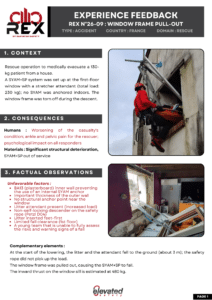
REX N°26-09 : WINDOW FRAME PULL-OUT

Rescue operation to medically evacuate a 130-kg patient from a house. A SYAM+SP system was set up at the first-floor window with a stretcher attendant (total load: 230 kg); no SYAM was anchored indoors. The window frame was torn off during the descent.

Download the report to read it in its entirety.
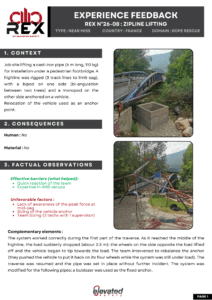
REX N°26-08 : ZIPLINE LIFTING

Job site lifting a cast-iron pipe (6 m long, 110 kg) for installation under a pedestrian footbridge. A highline was rigged (3 track lines to limit sag), with a bipod on one side (bi-angulation between two trees) and a monopod on the other side anchored on a vehicle. Relocation of the vehicle used as an anchor point.

Download the report to read it in its entirety.

REX N°26-07 : GINPOLE FOOT FAILURE

Mission to replace handrails on the platform of an offshore wind turbine: use of two monopods for two rope-access technicians fitting the new handrails. The articulated foot of the monopod was secured to the ground with a ratchet strap; the foot failed under load without the monopod itself falling, and the technician did not notice the failure.

Download the report to read it in its entirety.

REX N°26-06 : TREE FAILURE

Rescue of a paramotor pilot trapped between two trees (pines) at a height of 8 meters. Operation conducted deep in the forest, with no access for aerial lifts, thin-diameter trees, and a night time operation. Installation of guy wires (fragile trees). A tree snapped, causing the victim and the rescuer to fall approximately 4 meters.

Download the report to read it in its entirety.

REX N°26-05 : SWING RESCUE

During a Rope Rescue (GRIMP) proficiency training session, individual rescue exercise for team members: Swing rescue. Exercise conducted in an industrial environment at a known site with a prior risk assessment. Rescue of a casualty suspended on a rope by a single rescuer, performed from top to bottom. The rescuer fell 3 meters but was caught before hitting the ground.

Download the report to read it in its entirety.

REX N°26-04 : STRETCHER IMMERSION

Joint rescue exercise between water rescue and GRIMP (Rope Rescue) teams, simulating an injured casualty stranded on an island. Setup of a zipline to cross a 30m-wide river branch. Evacuation of a casualty on a stretcher (water rescue technician in full gear). Submerging the stretcher in the current.

Download the report to read it in its entirety.

REX N°26-03 : WELL RESCUE

Rescue of a conscious victim at the bottom of a well, inaccessible, with water up to the waist, leg trapped in a flexed position against the torso. The leg was freed by lowering a rope into the well to relieve the victim. The rescuer, who had descended headfirst, felt unwell.

Download the report to read it in its entirety.

REX N°26-02 : TRIPOD FALL

Off-site refresher training for a GRIMP team, consisting for this occasion of ten participants—including one team leader and one team member in training to become a team leader. Two simultaneous exercises were conducted across a large site. During a wall rescue operation on the ascent, the tripod fell as the stretcher arrived.

Download the report to read it in its entirety.

REX N°26-01 : ANCHOR REMOVAL

Training at the fire station on a rope equipment set up in a stairwell (GRIMP team). At the first anchor point, the anchor plate came loose from the concrete wall, causing the GRIMP technician to fall in two stages: first hitting the guardrail, then landing on the stairs. At the first re-anchor, the anchor plate came off the concrete wall, causing a two-stage fall: first onto the guardrail, then onto the stairs.

Download the report to read it in its entirety.

REX N°25-00 : GRIMPDAY 2025

A real-world Return of Experience (REX) from GRIMPDAY 2025 (Geneva): during the “Skyscraper” scenario, a rooftop gondola rail anchor system started drifting once loaded by several teams, forcing an immediate stop—and ultimately the cancellation of the scenario.

This document breaks down the context (multiple highlines in tension), what was observed on site, and the technical reasons behind the movement (rail assembly, joints, tie-back spacing). You’ll also find the corrective actions and practical recommendations.

Download it to capture clear, field-tested lessons you can apply to your own operations and event setups.